
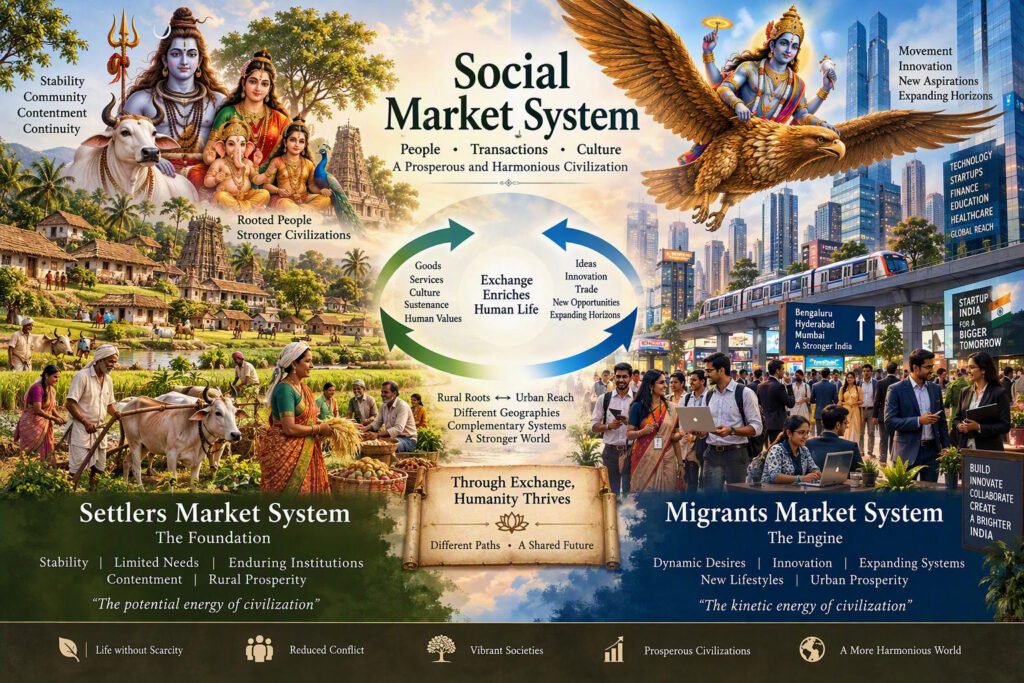
Social Market System
Primary purpose of civilization is to create conditions where humans can live a life without scarcity. Humans became civilized for this same reason. They created conditions through institutions and behaviors where animal tendencies can be avoided and live a conflict and violence free existence and still survive with vibrancy and prosperity. With these intentions, humans created farming and other kinds of systems to fulfill necessities of humans. Life is inherently simple in such ideal systems, where individuals need to only secure the necessities for sustenance that are readily available or humans are capable of obtaining through their own efforts from their surroundings. Because this ideal situation in society is difficult to create on a scale, there is always a need for transactions between people, required for exchanging goods and services. Establishing such a framework for transactions is the civilization itself.
There are multiple ways and frameworks established by different civilizations which are designed as per the conditions prevailing in those geographies. The currency for sustaining all such civilizational framework is the transaction cost. People who design the transactions and control the transactional ways and define the accumulated transactional outcomes, define the larger institutions of the civilization and the market systems of that civilization. Transactions create complexities of civilization, where there will be people who give and people who take. To avoid these transactional issues, Indian civilization designed culture, festivals, institutions like temples where the transaction are conducted as celebrations, devotion, duty etc avoiding duality and where there will be no givers or takers, but just an action executed out of Dharma. Because India is primarily a fertile land civilization, we could establish such a framework, which will also keep the institutional transactions to a bare minimum. Desert civilizations have a different way of designing their market system. Because desert civilizations rely heavily on travel and transport, interactions with such civilizations needed new ways of transactional frameworks.
Due to the need for sustained interaction with desert civilizations, fertile civilizations had to adopt methods of exchange. In this context, fertile civilizations may be viewed as rural, while desert civilizations may be viewed as urban centers that facilitate trade and social interaction. Indian civilization, often regarded as a continuous living civilization, appears weakened or less visible in many sections of its own urban society because urban life has increasingly moved away from its original fertile, rural foundations. A civilization can be understood through its market system and the tastes, values, and lifestyles that shape it. The way people choose to live changes their cultural preferences, and these shared preferences create demand, which in turn forms markets. Social habits act as a kind of currency, sustaining and expanding economic activity by influencing consumption and exchange. As people encounter alternatives that seem more influential, attractive or desirable, their aspirations gradually change, leading to shifts in lifestyle, values, and the market systems that emerge from them.
This shifting trends in society can be equated with shifting activities of mind. Changing individual preferences is not much different from changing social activities. These individual and social activities need the market where transactions happen. All the stimulations of mind, are also existing in the scintillating society. They give rise to necessities and cravings in the society just like they do for an individual. Social swings are not different from individual’s swings. Social market system can be understood by creating a parallel model with personal life in a micro view. Settled mind and unsettled mind of a person can be co-related to the Settler’s market system and Migrant’s market system of a society. Practically, each of these 2 market systems will have 2 sections i.e. consistently settled, inconsistently settled and consistently migrant, inconsistently migrant.
Let us delve into the 2 kinds of Social Market Systems :
Settlers Market System:
The Settlers Market System represents a society of individuals whose intentions are settled from a constant desire for novelty. Such people have limited needs defined by boundaries because their cognition cannot continuously sustain the desire for new possessions, or consumption patterns. They find contentment in the products and services supported within their surrounding community. They prefer untangled life, tranquility, relationships, and the exploration of non-physical dimensions of life than material acquisitions.
In a settler society, change occurs slowly. There is little social or economic flux, and goods, traditions, and institutions endure for long periods before being replaced. People maintain consistent needs because those needs can be fulfilled by locally available resources. Only extraordinary events, such as natural calamities or major disruptions, compel significant change.
Settlers can be viewed as the potential energy of civilization. They provide the stability and continuity upon which institutions are built. While migrants often generate new ideas, innovations, and movements, settlers execute and sustain them. The prosperity that migrants celebrate ultimately depends on the settled communities that anchor society and maintain its foundations.
This concept is symbolically reflected in Puranic stories of Shiva. His vehicle, Nandi the bull, which can travel in a limited boundary and used in farming represents a settler’s life. Shiva lives as a householder with a family. There are many Puranic stores of Shiva and his family members. The vehicles of his family members exist in natural contrast or opposition to one another. This symbolizes the coexistence of imperfections and tensions within life. Yet the family remains united. This reflects the essence of settlers: the ability to live harmoniously despite difficulties, contradictions, and limitations, without excessive expectations.
To truly understand the enduring foundations of human life and civilization, one must understand the settlers. They embody stability, resilience, contentment, and continuity.
Migrants Market System:
The cravings of our oscillating senses create a dynamic, ever-shifting ecosystem driven by the relentless desire for the latest and better things. The Migrants Market System emerges from this restless nature of human desires and continuously changing aspirations. The migrant-driven market system acts much like the human mind—wavering, impulsive, temporary, yet rich with flavor and immediate satisfaction. Nature is also like this cycle; fluctuating natural forces mirror these sensory cravings, continuously reshaping how societies organize themselves to fulfill their needs. Through this process, migrants become engine-drivers of innovation: they create new products and systems, either by adopting practices from cultures they encounter or by inventing novel solutions to the unique challenges they face during the movement.
In Hindu mythology, Lord Vishnu captures this kinetic essence. He rides Garuda, the swift vehicle capable of traversing any domain instantly. It represents a migrants capability to swiftly migrate all limitation and rigid frameworks, who is not bound by issues of structure. Vishnu is adorned in splendorous jewelry, with Goddess Lakshmi—the embodiment of wealth and prosperity—attending at his feet. Notably, Vishnu remains untethered by elaborate family structures in Puranic Lore; the stories focus primarily on the divine couple residing alongside their two celestial guards in the secluded realm of Vaikuntha. Vishnu has structural independence and isolation from typical familial ties.
Migrants represent pure kinetic energy, the ultimate drivers of social trajectories and cultural trends. Whenever people move, they spin up new economies, ignite fresh trends, and introduce generative instability. Migration functions much like human mood swings: it continuously triggers activity, and that activity generates capital. With every shift, people demand upgraded goods and new ways of living. Out of this continuous churning—the essence of Samsara—new social groups (Kulams) are born, with dominant groups emerging based on the prevailing social themes of the era.
Ultimately, migrants build institutions designed to mobilize and direct the labor of settled populations, forming the foundational source of migrant prosperity. The migrant market system is engineered at its core for the settled population to consume. Through this interplay, migrants with larger spheres of influence inevitably reshape and supersede smaller ones.

Leave your comment