
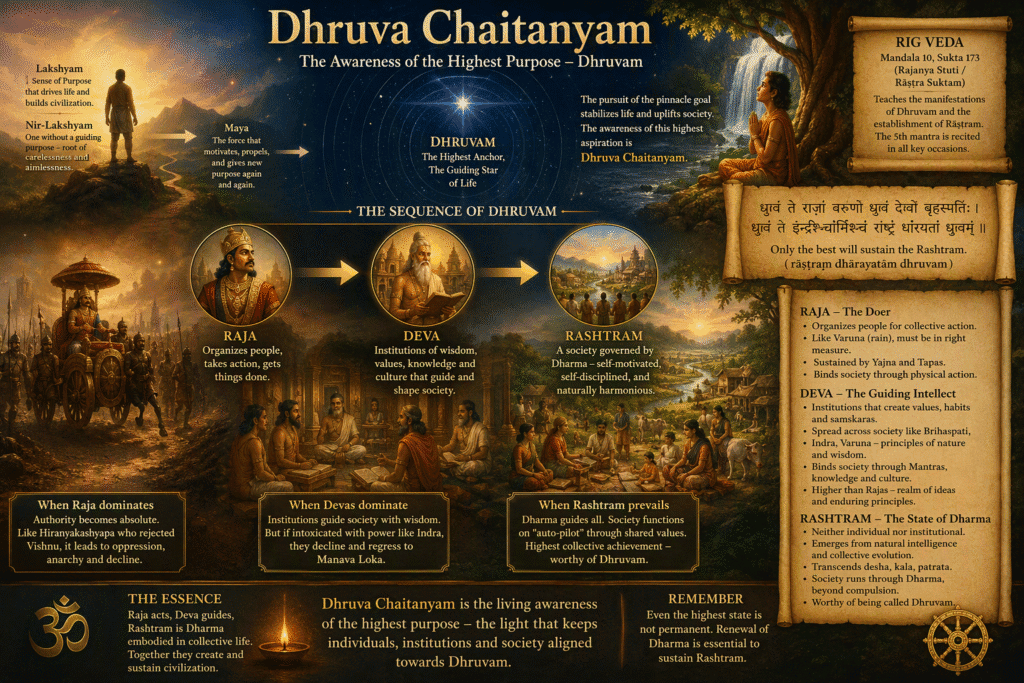
Dhruva Chaitanyam
Human beings are individuals by nature, much like all other animals. However, the necessities and aspirations of civilized life inspire people to organize themselves, cooperate, and evolve in pursuit of meaningful experiences and collective prosperity.
In this process, some individuals take on the responsibility of organizing, creating, and achieving. Their efforts establish the foundations upon which others can live stable and settled lives. Civilization itself stands upon the dedication and sense of purpose demonstrated by such individuals. This sense of purpose is called Lakshyam.
A person who lacks such purpose is referred to as Nir-Lakshyam. While this term is often translated as “careless,” its deeper meaning is “one without a guiding purpose.” In many ways, carelessness can indeed arise from the absence of a meaningful direction in life.
The force that drives an individual toward the purpose is called Maya. Maya motivates a person to pursue a purpose and strive toward achievement. Once a goal is attained, however, Maya can reveal the transient nature of fulfillment and inspire the individual to seek new objectives. Thus, the role of Maya is to continually propel individuals toward purposeful action and growth.
For human life to remain meaningful and productive, it is essential to possess a purpose. Purpose serves as an anchor, preventing the mind from scattering into aimlessness and protecting a person from a wasteful, directionless existence. The ultimate purpose, the highest anchor or guiding star in life, is called Dhruvam.
The pursuit of such pinnacle goals acts as a stabilizing force that prevents individuals from falling into complacency. The awareness of, and commitment to, this highest aspiration is known as Dhruva Chaitanyam.
The Vedas identify and explain to us many concepts that are called Dhruvam. Vedic mantras are used by Archakas and Purohits during the most significant moments of our lives, taking many different forms. They may be recited while celebrating life through occasions such as birthdays, organizing major events such as marriages, or commemorating festivals. They are also invoked during the coronation of a Raja, who organizes people toward goals greater than individual ambitions. These mantras are chanted when establishing enduring institutions, explaining ideas and ideologies through Puranic narratives such as the story of Dhruva in the Vishnu Purana, and during cultural, traditional, and religious activities of various kinds.
In every case, these pursuits represent humanity’s desire to create meaning, continuity, and collective achievement beyond the limits of individual life.
One such chanted Vedic Sukta that explains the concept of Dhruvam is found in the Rig Veda, Mandala 10, Sukta 173. This Sukta is commonly known as Rajanya Stuti and is generally recited during the coronation of Rajas. The Sukta instructs the Raja and explains the various manifestations of Dhruvam. It is also called Raṣṭra Suktam, as it explains the establishment and importance of sustaining the concept of Raṣṭram. The fifth mantra of this Sukta is repeated during all the occasions mentioned in the above paragraphs.
ध्रु॒वं ते॒ राजा॒ वरु॑णो ध्रु॒वं दे॒वो बृह॒स्पति॑: । ध्रु॒वं त॒ इन्द्र॑श्चा॒ग्निश्च॑ रा॒ष्ट्रं धा॑रयतां ध्रु॒वम् ॥
This mantra explains the progressive order of Dhruvam to a Raja, the authority entrusted with governing and organizing society, during his coronation. This Mantra begins with Raja, equating him with Varun. Then it speaks about Devas, represented by Brihaspati. Next, it invokes Indra and Agni as manifestations of Dhruvam. Then finally, the mantra proclaims only the best will sustain the Rashtram (रा॒ष्ट्रं धा॑रयतां ध्रु॒वम्).
Raja:
In common parlance, Raja is identified only with Rulers. But, a Raja can be anyone who organizes people to accomplish a task. As explained by Swami Vivekanand in his Raja Yoga, a Raja is someone who accomplishes a task in 1 day by organizing 10 people, which generally takes 10 days for 1 person. Raja is someone which represents and coordinates multitudes together. This is also why, in Jyotisha and traditional vocabulary Raja or Raja Yoga always does not necessarily imply becoming a king. It can refer to anyone who achieves results by effectively engaging and organizing multiple people.
Getting such a skilled person is as important as the Rain god (Varuna) for farming and generating a produce. Such a rain god should only come for the right amount; he can be devastating like a flood if it rains more than it is needed. Lack of such a Raja for those 10 people will create a drought situation where there will be no productive yield. Such a rain god is received only after pleasing devatas by performing a Yagna. Vedas propose the concept of Tapasvi Raja because Varuna is attained only by doing yagna with austerity. Raja is an individual ownership entity. This entity evolves and sustains/nourishes Devatas through Yagna. Rajas create and bind society with strands of physical actions.
Deva :
Devata is an institutional entity and it is above individual possession of Raja. These Deva ganas in society shape values and samskaras in the Minds and Habits of society. They are institutions and institution builders of society. Sanyasi (Sa+Nyasi = with institution (Nyasa) ), Ritviks who perform yagna etc are equated with Deva ganas. In modern terms, they may be equated to think tanks, intellectual eco system institutions, educational institutions, and other bodies that preserve and transmit knowledge and values. While Rajas bind society through physical action, Devas bind society through intellectual and cultural cohesion, using Mantras and shared vocabulary. They create the frameworks of meaning through which society understands itself.
Devatas can be non-individual divine entities like Brihaspathi, Indra, Varuna etc because they are spread across like institutions which sustains various forms of activity in nature. Brihaspati is called Deva in the mantra because Brihaspathi literally means owner (pathi) of the expansiveness (Brihat). Brihaspathi is a metaphor to explain the principle of growth, expansiveness, that which is spread across, that which is of higher principles. For this reason, Devatas are considered higher than Rajas. While Rajas operate primarily in the realm of action and governance, Devatas inhabit a higher realm of ideas, values, institutions, and enduring principles that outlast individual lives and activities.
Rashtram:
Rashtram is the embodiment of Dharma that guides and sustains society. It is a logical entity that emerges from natural intelligence and collective evolution. It differs from a conventional civilizational state that is established and maintained through rigid rules, laws, and external enforcement. A Rashtram, by contrast, is a state founded upon Dharma, rooted in eternal knowledge that transcends desha (place), kāla (time), and patrata (context or eligibility). While rules, laws, and social principles may change with time and circumstance, Dharma remains the enduring foundation.
Rashtram is neither an individual entity nor an institutional one. Rather, it is animated and sustained by Dharma itself. When the ideals of Dharma become deeply embedded in the minds, habits, and conduct of people, they manifest as culture. Rashtram represents a mature and highly evolved state of society in which the principles of Dharma are so thoroughly internalized that social order functions naturally, without dependence on individual authority or institutional control.
It is the highest collective achievement that a people can attain. The aspiration toward Rashtram requires a society that is self-motivated, self-disciplined, and guided by Dharma rather than by compulsion. Such a state of Rashtram, founded upon enduring principles and sustained by collective wisdom, alone is worthy of being called Dhruvam.
The mantra follows a deliberate sequence, introducing first the Raja, then the Deva, and finally the Rashtram, representing progressively higher and more effective forms of social organization. All three exist simultaneously in any society, but the relative dominance of one over the others reflects the condition and maturity of that society.
A less evolved society is characterized by the overwhelming influence of the Raja, where authority is concentrated in an individual who dictates every aspect of collective life. Such a condition may be compared to Hiranyakashyapa, who rejected Vishnu and subordinated all higher principles to his own will. A society dominated solely by such authority risks suffering under arbitrary or tyrannical rule.
In societies with ideal Rajas, the Devas, represented by institutions and institutional leaders, play an active role in guiding and sustaining the social order. These institutions provide continuity, wisdom, and intellectual direction. However, institutions may themselves become intoxicated by their influence and effectiveness, much as Indra is sometimes portrayed in the Puranic narratives. When this occurs, they decline from their higher function and regress to the level of ordinary human concerns (Manava Loka).
The highest form of society is the Rashtram, which operates with Dharma as its guiding force. In such a state, social order functions largely through the internalization of Dharma rather than through external compulsion. People do not require constant inspiration, enforcement, or impulse to perform their duties; they act naturally in accordance with Dharma. Society thus functions almost on “auto-pilot,” sustained by shared values and collective understanding rather than by individuals or institutions alone.
Yet even such an ideal state is not permanent. Over time, natural forces tend to pull every perfected condition back toward a more ordinary equilibrium. Consequently, a Rashtram must continually renew and re-establish its foundation in Dharma if it is to preserve its highest state.
In this process, some individuals take on the responsibility of organizing, creating, and achieving. Their efforts establish the foundations upon which others can live stable and settled lives. Civilization itself stands upon the dedication and sense of purpose demonstrated by such individuals. This sense of purpose is called Lakshyam.
A person who lacks such purpose is referred to as Nir-Lakshyam. While this term is often translated as “careless,” its deeper meaning is “one without a guiding purpose.” In many ways, carelessness can indeed arise from the absence of a meaningful direction in life.
The force that drives an individual toward the purpose is called Maya. Maya motivates a person to pursue a purpose and strive toward achievement. Once a goal is attained, however, Maya can reveal the transient nature of fulfillment and inspire the individual to seek new objectives. Thus, the role of Maya is to continually propel individuals toward purposeful action and growth.
For human life to remain meaningful and productive, it is essential to possess a purpose. Purpose serves as an anchor, preventing the mind from scattering into aimlessness and protecting a person from a wasteful, directionless existence. The ultimate purpose, the highest anchor or guiding star in life, is called Dhruvam.
The pursuit of such pinnacle goals acts as a stabilizing force that prevents individuals from falling into complacency. The awareness of, and commitment to, this highest aspiration is known as Dhruva Chaitanyam.
The Vedas identify and explain to us many concepts that are called Dhruvam. Vedic mantras are used by Archakas and Purohits during the most significant moments of our lives, taking many different forms. They may be recited while celebrating life through occasions such as birthdays, organizing major events such as marriages, or commemorating festivals. They are also invoked during the coronation of a Raja, who organizes people toward goals greater than individual ambitions. These mantras are chanted when establishing enduring institutions, explaining ideas and ideologies through Puranic narratives such as the story of Dhruva in the Vishnu Purana, and during cultural, traditional, and religious activities of various kinds.
In every case, these pursuits represent humanity’s desire to create meaning, continuity, and collective achievement beyond the limits of individual life.
One such chanted Vedic Sukta that explains the concept of Dhruvam is found in the Rig Veda, Mandala 10, Sukta 173. This Sukta is commonly known as Rajanya Stuti and is generally recited during the coronation of Rajas. The Sukta instructs the Raja and explains the various manifestations of Dhruvam. It is also called Raṣṭra Suktam, as it explains the establishment and importance of sustaining the concept of Raṣṭram. The fifth mantra of this Sukta is repeated during all the occasions mentioned in the above paragraphs.
ध्रु॒वं ते॒ राजा॒ वरु॑णो ध्रु॒वं दे॒वो बृह॒स्पति॑: । ध्रु॒वं त॒ इन्द्र॑श्चा॒ग्निश्च॑ रा॒ष्ट्रं धा॑रयतां ध्रु॒वम् ॥
This mantra explains the progressive order of Dhruvam to a Raja, the authority entrusted with governing and organizing society, during his coronation. This Mantra begins with Raja, equating him with Varun. Then it speaks about Devas, represented by Brihaspati. Next, it invokes Indra and Agni as manifestations of Dhruvam. Then finally, the mantra proclaims only the best will sustain the Rashtram (रा॒ष्ट्रं धा॑रयतां ध्रु॒वम्).
Raja:
In common parlance, Raja is identified only with Rulers. But, a Raja can be anyone who organizes people to accomplish a task. As explained by Swami Vivekanand in his Raja Yoga, a Raja is someone who accomplishes a task in 1 day by organizing 10 people, which generally takes 10 days for 1 person. Raja is someone which represents and coordinates multitudes together. This is also why, in Jyotisha and traditional vocabulary Raja or Raja Yoga always does not necessarily imply becoming a king. It can refer to anyone who achieves results by effectively engaging and organizing multiple people.
Getting such a skilled person is as important as the Rain god (Varuna) for farming and generating a produce. Such a rain god should only come for the right amount; he can be devastating like a flood if it rains more than it is needed. Lack of such a Raja for those 10 people will create a drought situation where there will be no productive yield. Such a rain god is received only after pleasing devatas by performing a Yagna. Vedas propose the concept of Tapasvi Raja because Varuna is attained only by doing yagna with austerity. Raja is an individual ownership entity. This entity evolves and sustains/nourishes Devatas through Yagna. Rajas create and bind society with strands of physical actions.
Deva :
Devata is an institutional entity and it is above individual possession of Raja. These Deva ganas in society shape values and samskaras in the Minds and Habits of society. They are institutions and institution builders of society. Sanyasi (Sa+Nyasi = with institution (Nyasa) ), Ritviks who perform yagna etc are equated with Deva ganas. In modern terms, they may be equated to think tanks, intellectual eco system institutions, educational institutions, and other bodies that preserve and transmit knowledge and values. While Rajas bind society through physical action, Devas bind society through intellectual and cultural cohesion, using Mantras and shared vocabulary. They create the frameworks of meaning through which society understands itself.
Devatas can be non-individual divine entities like Brihaspathi, Indra, Varuna etc because they are spread across like institutions which sustains various forms of activity in nature. Brihaspati is called Deva in the mantra because Brihaspathi literally means owner (pathi) of the expansiveness (Brihat). Brihaspathi is a metaphor to explain the principle of growth, expansiveness, that which is spread across, that which is of higher principles. For this reason, Devatas are considered higher than Rajas. While Rajas operate primarily in the realm of action and governance, Devatas inhabit a higher realm of ideas, values, institutions, and enduring principles that outlast individual lives and activities.
Rashtram:
Rashtram is the embodiment of Dharma that guides and sustains society. It is a logical entity that emerges from natural intelligence and collective evolution. It differs from a conventional civilizational state that is established and maintained through rigid rules, laws, and external enforcement. A Rashtram, by contrast, is a state founded upon Dharma, rooted in eternal knowledge that transcends desha (place), kāla (time), and patrata (context or eligibility). While rules, laws, and social principles may change with time and circumstance, Dharma remains the enduring foundation.
Rashtram is neither an individual entity nor an institutional one. Rather, it is animated and sustained by Dharma itself. When the ideals of Dharma become deeply embedded in the minds, habits, and conduct of people, they manifest as culture. Rashtram represents a mature and highly evolved state of society in which the principles of Dharma are so thoroughly internalized that social order functions naturally, without dependence on individual authority or institutional control.
It is the highest collective achievement that a people can attain. The aspiration toward Rashtram requires a society that is self-motivated, self-disciplined, and guided by Dharma rather than by compulsion. Such a state of Rashtram, founded upon enduring principles and sustained by collective wisdom, alone is worthy of being called Dhruvam.
The mantra follows a deliberate sequence, introducing first the Raja, then the Deva, and finally the Rashtram, representing progressively higher and more effective forms of social organization. All three exist simultaneously in any society, but the relative dominance of one over the others reflects the condition and maturity of that society.
A less evolved society is characterized by the overwhelming influence of the Raja, where authority is concentrated in an individual who dictates every aspect of collective life. Such a condition may be compared to Hiranyakashyapa, who rejected Vishnu and subordinated all higher principles to his own will. A society dominated solely by such authority risks suffering under arbitrary or tyrannical rule.
In societies with ideal Rajas, the Devas, represented by institutions and institutional leaders, play an active role in guiding and sustaining the social order. These institutions provide continuity, wisdom, and intellectual direction. However, institutions may themselves become intoxicated by their influence and effectiveness, much as Indra is sometimes portrayed in the Puranic narratives. When this occurs, they decline from their higher function and regress to the level of ordinary human concerns (Manava Loka).
The highest form of society is the Rashtram, which operates with Dharma as its guiding force. In such a state, social order functions largely through the internalization of Dharma rather than through external compulsion. People do not require constant inspiration, enforcement, or impulse to perform their duties; they act naturally in accordance with Dharma. Society thus functions almost on “auto-pilot,” sustained by shared values and collective understanding rather than by individuals or institutions alone.
Yet even such an ideal state is not permanent. Over time, natural forces tend to pull every perfected condition back toward a more ordinary equilibrium. Consequently, a Rashtram must continually renew and re-establish its foundation in Dharma if it is to preserve its highest state.

Leave your comment