
Concept Of NamaRupa
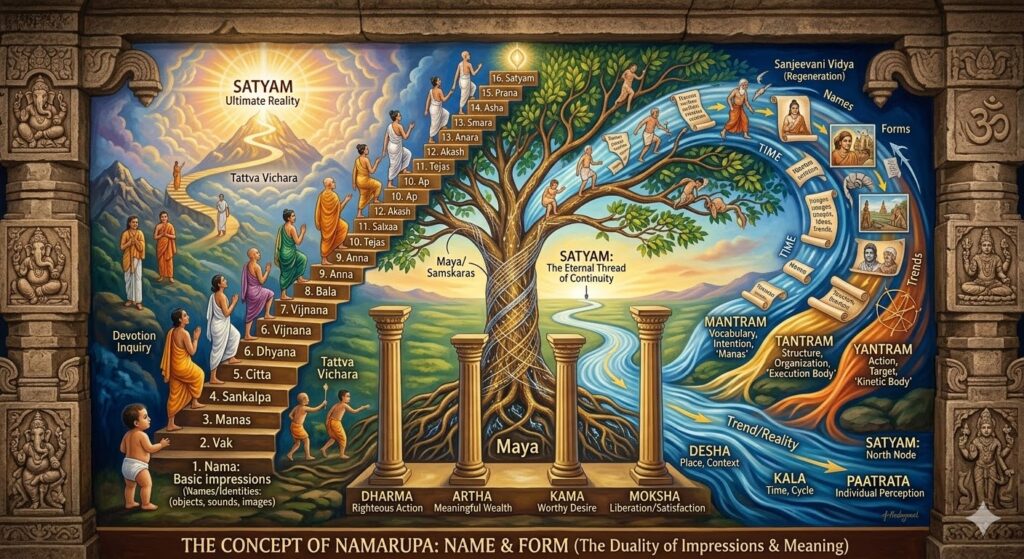
Sequence of intellectual ascendance starts with Nama as the most basic starting point for experiencing the ultimate. Then the sequence gets more refined. As mentioned in Chandogya Upanishad seventh chapter, it goes up to 16 steps to reach till Satyam. These are the steps of increasing higher intelligence which starts with Name or Identity as the starting point. This sequence starting with identity, explains the increasing ladder of progress for Human awareness. People start their journey of consciousness by identifying existence/reality with a Name, as he enquires further and does tattva vichara, relevant forms or patterns emerge until he reaches the experience of ultimate. Like a just born toddler, who, after coming into this world, initially starts recording impressions as identities. He starts to record them into his brain as images, as sounds, as touch, as taste, as smell and as he grows up, he processes them. Human brain is a self-organized memory; it extracts meaning out of the accumulated unexplained impressions. All the accumulated impressions (Nama) create meaning (Rupa) according to the gravitational points surrounding them. These meanings settle as Samskaras, and the individual grows with them. These gravitational points are the Maya which an individual earns from his accumulated past actions called Prarabdham. This duality of impressions and meaning, identity and institution, name and form etc is the concept of NamaRupa.
- Dharma: All actions that are worthy of taking up and which deserve to be sustained.
- Artha: All that is meaningful and tangible, an outcome which is translated from the action taken as Dharma.
- Kama: All that purpose, which is worthy of fulfilling through the tangible meaning which is earned.
- Moksha: All the satisfaction and peaceful equilibrium gained through the fulfilment of purpose.
- Mantram: The vocabulary which constructs the logical and metaphysical mental structure called Manas for generating intension and sustained purpose.
- Trantram: The structure for executing the intension and purpose through an efficient organizing body which has the potential to achieve needed outcomes.
- Yantram: The kinetic body which uses the established structure for achieving targets set through Mantram and Tantram.
- Desha: Names are valid only in a defined place for its related form. The form of that name may change after the place changes relatively.
- Kala: Identification for the meaning is valid only in a time frame. The meaning for the identification may change in a different period.
- Paatrata: Perception and reality may change according to the unique experiences of individuals who are bounded by Desha and Kala.
