
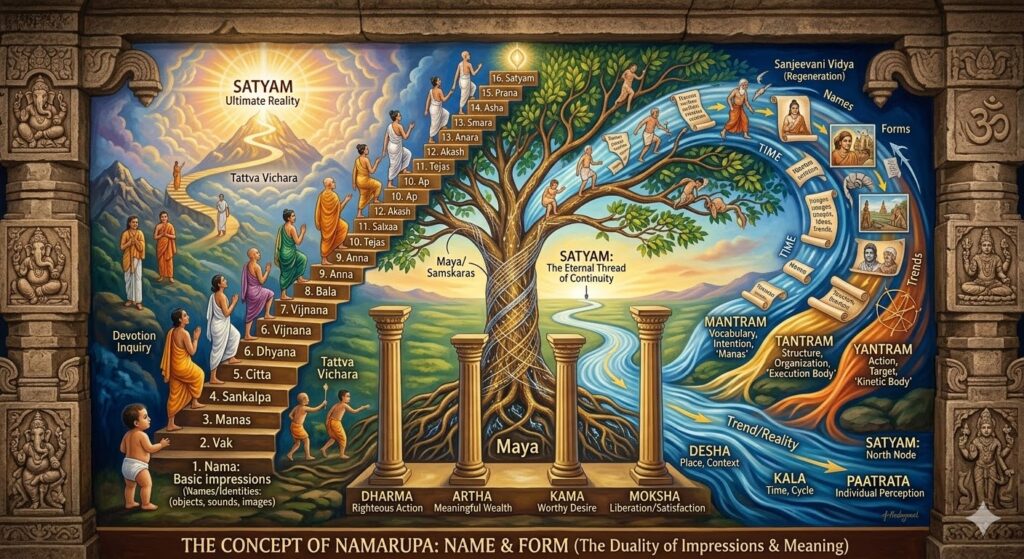
Concept Of NamaRupa

Concept Of NamaRupa

Sequence of intellectual ascendance starts with Nama as the most basic starting point for experiencing the ultimate. Then the sequence gets more refined. As mentioned in Chandogya Upanishad seventh chapter, it goes up to 16 steps to reach till Satyam. These are the steps of increasing higher intelligence which starts with Name or Identity as the starting point. This sequence starting with identity, explains the increasing ladder of progress for Human awareness. People start their journey of consciousness by identifying existence/reality with a Name, as he enquires further and does tattva vichara, relevant forms or patterns emerge until he reaches the experience of ultimate. Like a just born toddler, who, after coming into this world, initially starts recording impressions as identities. He starts to record them into his brain as images, as sounds, as touch, as taste, as smell and as he grows up, he processes them. Human brain is a self-organized memory; it extracts meaning out of the accumulated unexplained impressions. All the accumulated impressions (Nama) create meaning (Rupa) according to the gravitational points surrounding them. These meanings settle as Samskaras, and the individual grows with them. These gravitational points are the Maya which an individual earns from his accumulated past actions called Prarabdham. This duality of impressions and meaning, identity and institution, name and form etc is the concept of NamaRupa.
A person who is untouched with ever tantalizing changing nature has the ability to create new names and forms to achieve his targets, this is called NamaRupa vidya. Such NamaRupa sadhana gives freedom from bondage and entanglements. It is the same vidya through which shukracharya recreates asuras. He gets this Sanjeevani Vidya as boon from Shiva after he releases Shukra from his Skalana. The concept of NamaRupa is the source of Sanjeevani Vidya. Vishnu also takes a new avatara every time there is a problem. There are 9 categories in which Vishnu takes form, each category is represented with each graha in Jyotishya which is a category of relevant regeneration. Regeneration is the core of NamaRupa Sadhana. Regeneration happens to bring a deep transformative experience. This will be required to placate a deteriorating reality or when a vacuum-like situation is present and there is no support to create reality as a new Name and Form. Evey NamaRupa which comes into existence will perish after a period, this is the same concept explained by Krishna in Bhagavad Gita when he says everything which is born will die. This death is applicable to all Names and forms of which human life is one, same concept extends to thoughts, desires, ideas, ideologies, civilizations, societies, trends etc . New names and forms are created in the cycles of time.
Existence comes into awareness as NamaRupa. To sustain such an existence for a duration of time until its extinction, Maya needs to be established on an elevated foundation of 4 pillars called 1. Dharma 2. Artha 3. Kama 4. Moksha. Without the support of these pillars maya will collapse and a new Maya as NamaRupa needs to be created because Maya is Chanchala and it is not constant or consistent, it takes different forms as its natural state. Sustainable maya is established with below 4 pillars:
  1. Dharma: All actions that are worthy of taking up and which deserve to be sustained.
  2. Artha: All that is meaningful and tangible, an outcome which is translated from the action taken as Dharma.
  3. Kama: All that purpose, which is worthy of fulfilling through the tangible meaning which is earned.
  4. Moksha: All the satisfaction and peaceful equilibrium gained through the fulfilment of purpose.
Such established maya streams into existence in below 3 steps:
  1. Mantram: The vocabulary which constructs the logical and metaphysical mental structure called Manas for generating intension and sustained purpose.
  2. Trantram: The structure for executing the intension and purpose through an efficient organizing body which has the potential to achieve needed outcomes.
  3. Yantram: The kinetic body which uses the established structure for achieving targets set through Mantram and Tantram.
NamaRupa which is created through the established Maya plays differently in the outer world. It varies according to the 3 below:
  1. Desha: Names are valid only in a defined place for its related form. The form of that name may change after the place changes relatively.
  2. Kala: Identification for the meaning is valid only in a time frame. The meaning for the identification may change in a different period.
  3. Paatrata: Perception and reality may change according to the unique experiences of individuals who are bounded by Desha and Kala.

Creation of Names and forms should follow direction of the flowing trend. Like the flowing water, reality is unstoppable until it reaches it destiny. You can build a dam to temporarily store some of the reality when an unsustainable situation happens. But ultimately you have to let go off the situation and flow in the direction of the trend. When creating NamaRupa through a new maya, it is important to hold on to an anchor point because that is the north node. Without the reference anchor you are lost in the chaotic stream without any direction. The anchor is the bank where you will ultimately reach after all the rush you go through many names and forms. The underlining satyam for all these changes is the anchor foundation, which is ever consistent. This vidya keeps the thread of continuity even when the outer form of maya keeps changing/recreating. This underlying thread of satyam keeps the garland of different names and forms to continue as a single relevant stack. After a threshold, we will realize that all identities are hollow and ever changing, and no identity is absolute. Even a simple inquiry into the identity uncovers its fallacies. The natural state is the ultimate form which was consistent, which is consistent, and which will be consistent.

On a mission to be the world’s largest and most comprehensive listing directory for Hindu temples

Statistics

17 TEMPLES worldwide
5898 PEOPLE unique visitors
5 REVIEWS shared over

Copyright © 2025 Sanatan Yatri. All Rights Reserved.